

For the executive
One name goes on the
report. Know what's under it.
CommandCenter doesn't hand you a dashboard and hope. It gates what leaves the building behind a sign-off only an owner or exec can give, compiles the report that sign-off is built on, runs the standing committee that governs what happens between audits, and tells you — department by department — whether what you're looking at is a real institution or one person's memory away from gone.
Before anything leaves the building
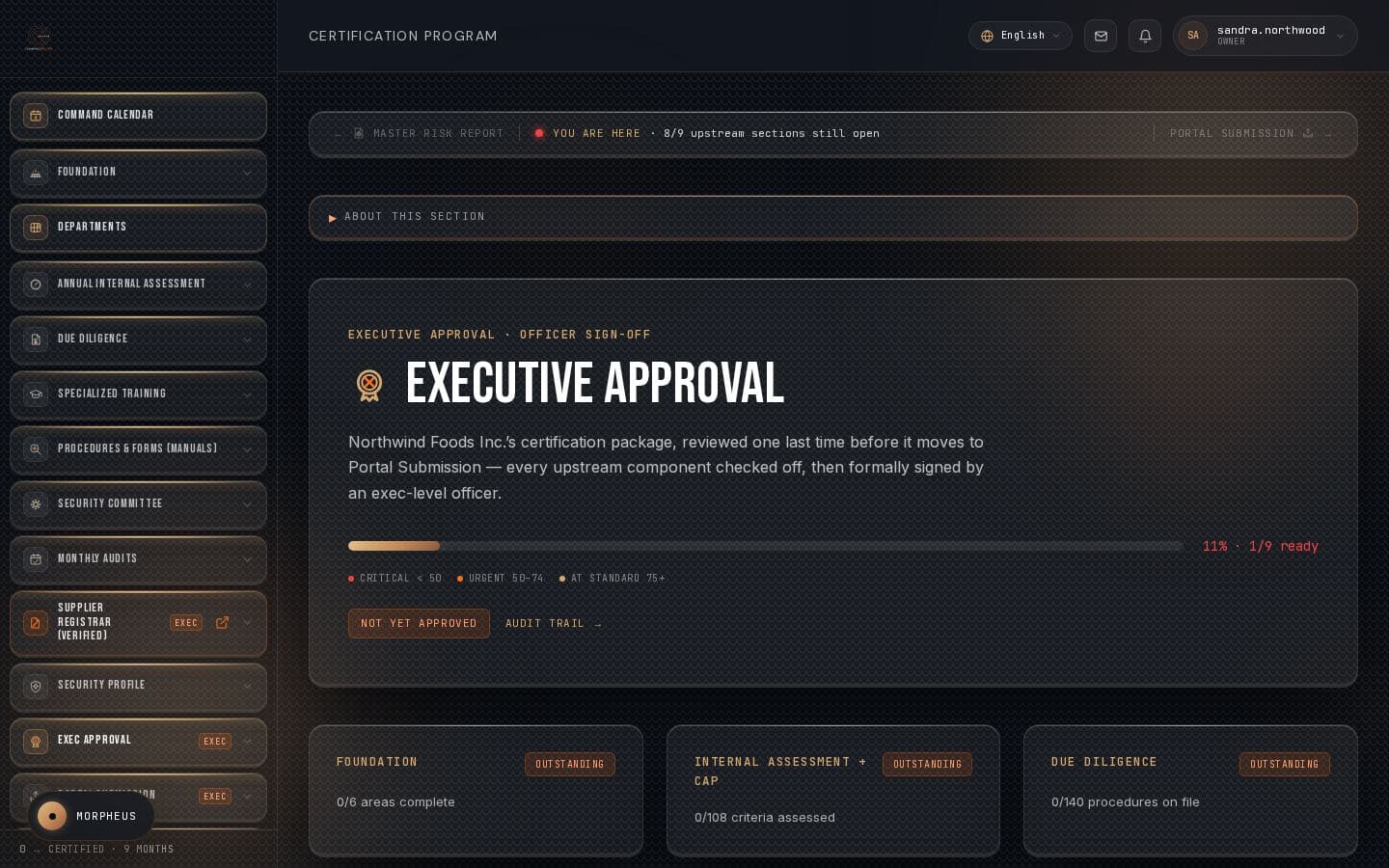
The exec-approval gate
Nine sections have to be genuinely complete — by that section's own definition, not a softer one for this checklist — before the package is even eligible for sign-off. Only an owner or an exec-level officer can sign it, or revoke it later if something changes. Nothing is ever marked approved by default.
- 1Foundation. The company profile, facilities, and programs this report is built on.
- 2Internal Assessment + CAP. Every department scored, every gap opened as a tracked corrective action.
- 3Due Diligence. The supplier and partner review behind the chain, not just the four walls.
- 4Specialized Training. Each department's own curriculum, completed and on record.
- 5Monthly Audits. The recurring internal check, not a once-a-year fire drill.
- 6Security Committee. Standing governance — real incidents, real minutes, real decisions.
- 7Security Profile. The company's own written security posture, section by section.
- 8Evidence. The documents and proof underneath every claim above.
- 9Master Risk Report. Everything above, compiled into the one report your name goes on.
What the gate produces
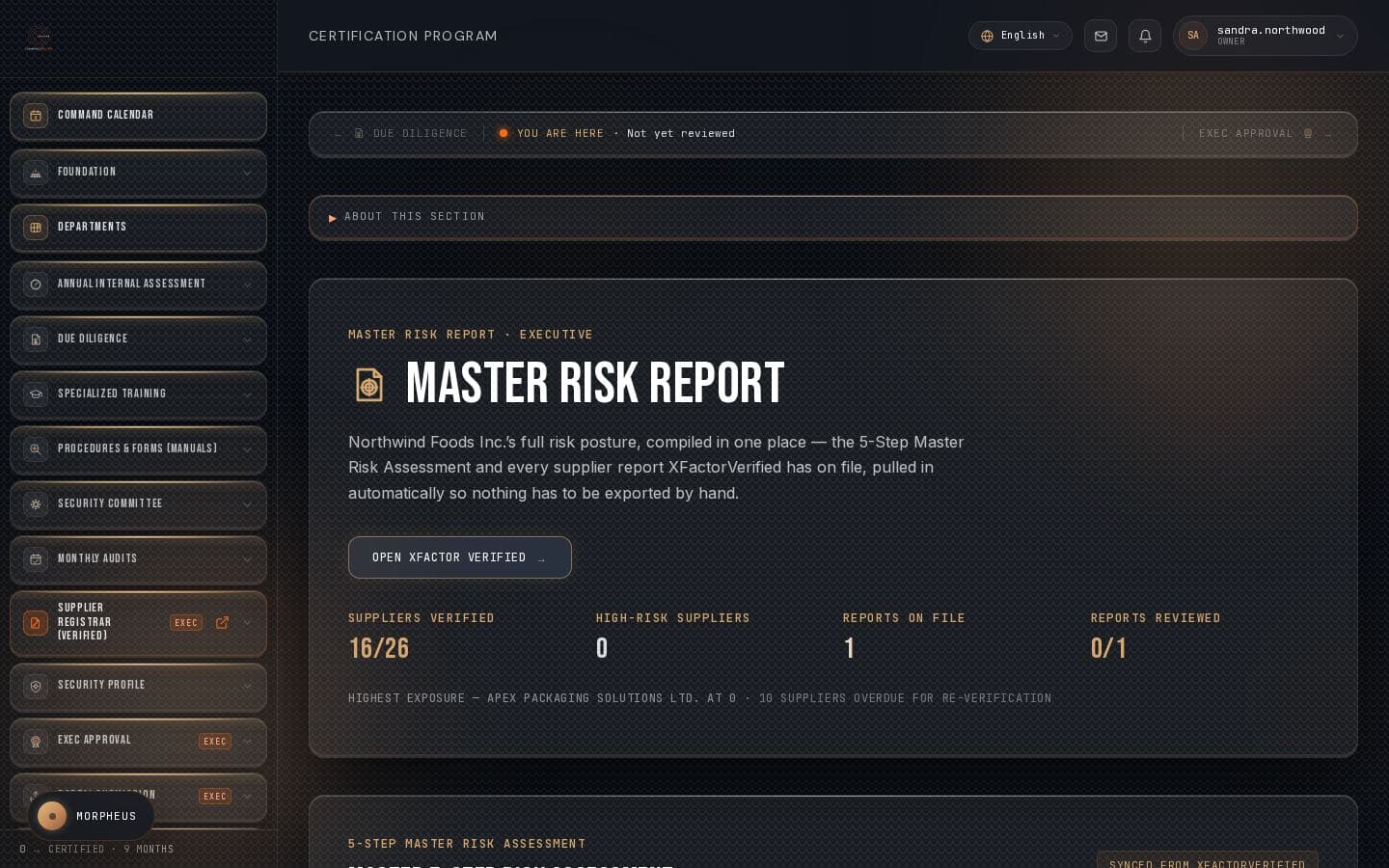
The Master Risk Report
Everything above compiles into one report — the company's own risk picture and every supplier's, in one place, not nine tabs you reconcile by hand.
XFACTOR VERIFIED is the easy button underneath it. VERIFIED is what generates the full, in-depth 5-Step Risk Assessment and Bill S-211 report — and VERIFIED is offered as part of the CommandCenter platform. That's the mechanism: the depth of a standalone risk-assessment product, surfaced inside the one report your name goes on.
Between audits
The Security Committee
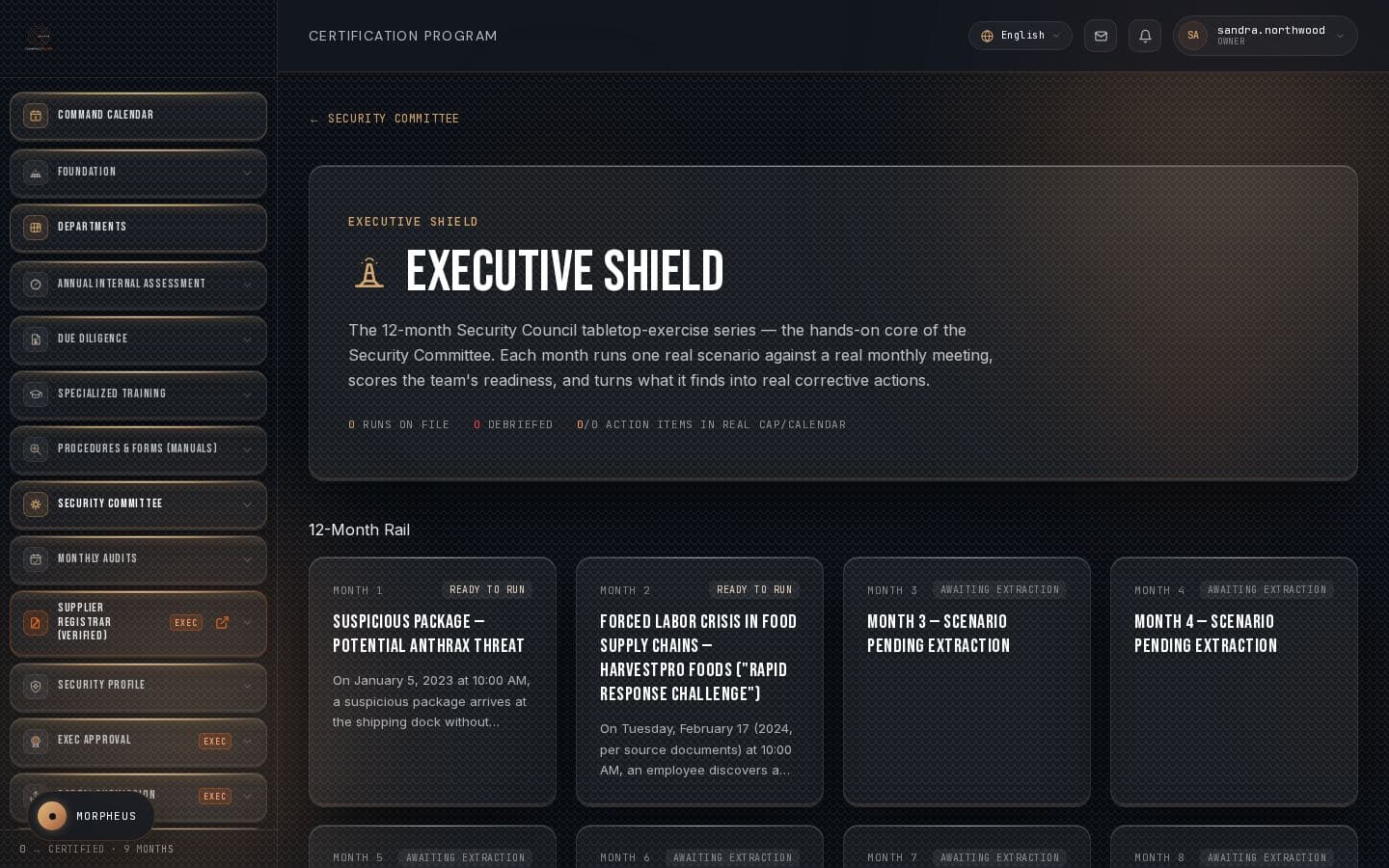
A standing committee with a generated agenda — built from your company's own open incidents and corrective actions, not a blank template someone fills in the night before. Every meeting keeps real minutes, and nothing on the agenda is invented.
Meetings can run as a live tabletop exercise — a real incident scenario, role guides, decisions logged as they're made, and the after-action report feeding straight back into your corrective-action ledger and calendar. Told straight: the tabletop engine is built and live; the scenario library is still filling in — two scenarios are ready to run today, ten more are in production.
The read no dashboard gives you — the Institution Ladder
Every department gets scored on two axes at once — how much the PEOPLE know, and how much the PROCESS carries without them — and the read is never hand-set. It's computed, department by department, straight from the assessment. Four places a department can land:
Sharp people, deep institution.
Protect it with the self-improvement loop — this is the department other departments should look like.
Runs great today — collapses on departure.
Capture their knowledge into written procedures, templates, and forms now, before it walks out the door.
Binders exist. Nobody lives them.
The fix is training and culture, not more documents — another binder makes this worse, not better.
Weak on both axes — no written process and no one holding it in their head either.
Document and train, sequenced — this is where an auditor finds you first.
Know the difference between run-great and built-to-last.
One gate before anything leaves the building. One report underneath your name. One committee that never goes quiet between audits.